
How to choose a heat press: from first orders to batch production
Your first personalised T-shirts and a steady flow of repeat textile orders may call for different heat presses. Platen size and maximum temperature are only part of the decision. Consider the products you will decorate, how you will position them and how many manual operations you will repeat throughout the day.
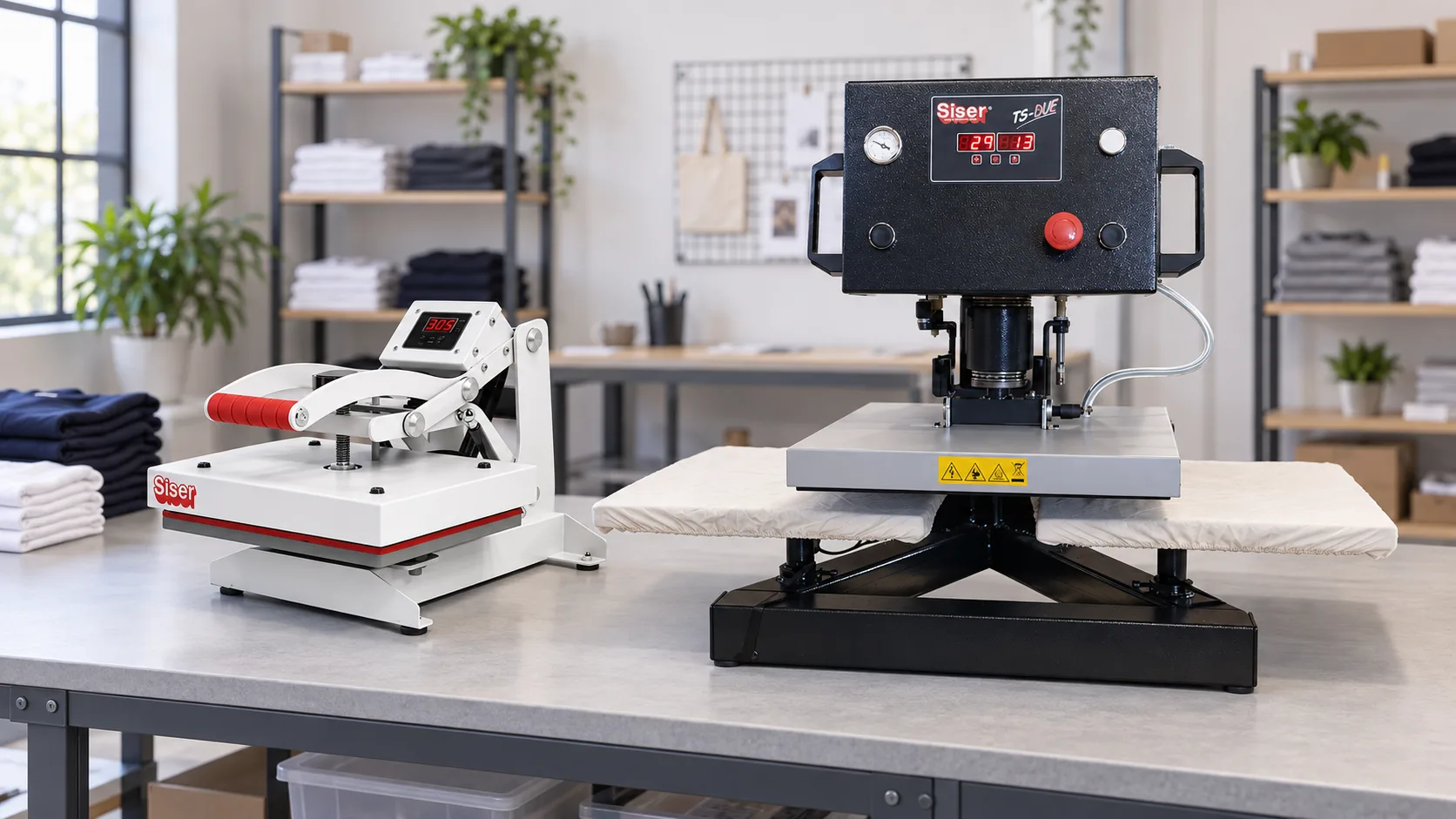
Start with the product and the design
List your most common jobs: small logos, large back prints, workwear, bags or caps. Choose a platen around the largest design you regularly apply and the space needed to position the item comfortably.
A larger platen does not automatically make a press more versatile. Smaller interchangeable platens may be more useful for small details or awkwardly shaped items. Check the accessories and package contents for the exact model: an accessory shown in a photograph is not necessarily included.
Clamshell or swing-away?
A clamshell press lifts its heating platen above the work area. A swing-away model moves the upper assembly away from the lower platen, allowing you to position the item without the heating platen directly overhead.
The Siser TS One, for example, has a swing-away upper arm. This layout requires clearance for the full movement, not just the closed machine. With either design, check the open dimensions and the manufacturer’s required safety clearances.
Manual or pneumatic?
A manual press is worth considering when jobs vary, orders are small and pressing is not a continuous all-day operation. Before buying, assess the closing effort, handle reach and pressure adjustment in practice.
A pneumatic press uses compressed air to generate pressing force. This can reduce the effort involved in manual closing, but it introduces air-supply requirements. The Siser TS Due, for example, needs a separate compressor that is not included. Compressor pressure and airflow must meet the requirements in the specific press documentation.
When do two workstations help?
Two supporting platens let you prepare the next item at a separate workstation while pressing is under way. The Siser TS Due is one example of this layout.
Two workstations do not automatically double output. Positioning the garment, preparing the transfer, the pressing cycle and subsequent steps all affect throughput. Before choosing, test the complete workflow for a typical order rather than simply closing the press.
Judge the process, not the maximum temperature
Select temperature, time and pressure for the particular transfer material and textile. There is no universal setting for all heat-transfer vinyl, DTF transfers and sublimation.
Run a trial on the intended item before starting a batch. Check the transfer result and follow the material manufacturer’s instructions for carrier removal, any additional pressing and care.
A short selection checklist
Answer these five questions before buying:
- What is the largest design you regularly apply?
- What shapes and thicknesses will you work with?
- Which part of an order takes the most time?
- Is there enough space, electrical capacity and, where needed, compressed air?
- Which accessories are included, and which must be bought separately?
Choosing a heat press? Include your products, design dimensions and typical order size in your enquiry so that suitable models can be compared against your actual work.